Monday, January 26, 2015


Mons Vipera

croActive holidays
view to a hill
It's a grey and rainy day in Korčula, jugo wind is showing its consistency and persistency in keepeing you inside...ideal for many indoor activities such as cooking, watching a film from a couch or brainstorming. Through the window and clouds I percieve the mountain of Zmijino brdo also known as Mons vipera (Viper's mountain) or Perun's mountain, and its peak Sveti Ilija.

across the sea
Its presence dominates the area of Pelješac and north-east side of Korčula island. It rises 961 m above sea level as a giant from some old tales not really interested in people but rather happy when left alone. Occasionally gets angry and then it's not a place to be there. But we all know that storms come and go and blue sky appears again as if it has never rained before. 

Orebić
A group of us, friends, went few weeks ago up there to spend a night in the so called hunters' cabin (half an hour walk from the top) and the forecast said it would rain at night. We contacted the local Mountaineering Club Sv. Ilija from Orebić to get the hut key and they said somebody was already up there so there was nothing to worry.


hike up
Our pace was moderate and we got there just in time to organize wood for fire and then after a grill and homemade wine right when we got into our sleeping bags the clouds swallowed the mountain and began pouring down its wet content. It felt nice being inside, protected. It seemed we were the only people in the world and I imagined us from say, a perspective of Korčula, when on such a day you only see two thirds of Ilija and the rest dissapears in the clouds like some lost and distant world. 

in the mountain
Wind gusts and showers went on whole night, and finally the morning cleared the sky so after breakfast we went to the top plateau to admire the view to the mainland and distant mountains of Croatia, Bosnia and Montenegro to the north and islands of Mljet, Korčula, Lastovo, Sušac, Vis, Hvar...on a day with a really good visibility it's possible to see the most remote islets of Palagruža and even the Italian coast. 

the ridge
Spectacular landscape includes the ridge of the peninsula of Pelješac itself resembling a long and jagged dormant beast winding and streching for 65 kilometers. If one wanted to venture into exploring numerous coves, fields, vineyards, taverns and wine cellars, villages, not to mention history, it would take time but it's nice to know that there is always something new and different to come back to.
 
sage
   
prickly juniper


Like this mountain; from its foothill you mostly see rock and little greenery and when you start ascending it, like we did, taking the east, steeper trail, it is fascinating how suddenly you're walking surrounded by trees and when you arrive to the plateau leading to the cabin it is even more green and fertile then expected, tall, mighty black pines stand in harmony with hibernating sage and prickly juniper forming such a delighting scene that you soon start thinking you have to be back in springtime when they are blooming.

black Dalmatian pines
As for the animal world the most common is to spot moufflons, but they share the mountain with more elusive jackals, boars, rabbits, falcons, hawks, vipers, owls, pheasants, grouses, and many other birds species. Seeing hoarses roaming some lower parts of the mountain is no surprise either. In order to encounter some of the wildlife one should be silent, spend more time in the mountain or simply be lucky, perhaps armed with a binocular.
 
...because it's there...
The way down took us more to the west in a milder but longer trail, first through the trees and then it started turning back towards our starting point in Orebić with views opening once again to Korčula island and town with all the islets spread out in the strait. And then the chapel of Lady of Karmen and its cypresses gave us one more opportunity to stop for a moment and reflect on all the wonderful things and sights we've met along the way.

a view to Korčula and Lumbarda
To summarise, Sveti Ilija is a wild and beautiful mountain with good and marked trails, an ecological heaven only a couple of hours walk from the sea level, so if you happen to be in the area and have a „hiking problem“, that's a place to go, particularly in spring or autumn when conditions and temperatures are generally more favourable.


Friday, January 2, 2015

KORČULA AND THE FALL/WINTER OF 2014/2015

croActive holidays
Vela Spila cave

It's off season and what can you do on the Black Korkyra island when the summer heat resides only in the photos or memories, crowds are gone, mainly to their northern, more permanent addresses , many restaurants and bars are closed, sun is not so bold or omnypresent anymore...Cold bora when blowing clears minds but also makes jackets come out of closets, jugo on the other hand is a warm wind but often goes hand in hand with rain that sometimes resembles monsoons. Still, many days are sunny and warm enough. So, the big question is again, what is there or here to do at this time of year?


The answer is simply YES. Ok, maybe no bar is open in the very old center of Korčula town, maybe connections with the rest of the world are not the most frequent ones, maybe days are short, maybe you don't find busy social life and so on...BUT, once you're here and start digging, a string of situations happen to emerge from somewhere as if drawn by some hard-to-detect force just being around all the time waiting to absorb and be absorbed.


The truth is everywhere around but mostly in the nature surrounding us and that seems like a great starting point to connect to the island or at least one way to do it. And not a hard one either...If you like to do these things on your own and don't need/know any locals willing to help you out, or they are engaged,  you can always get a map and get going out there searching for meditation in motion and mechanisms how our world came to be like we see it today. As it occurs so often, both mythology and past realities edited into the history through history still co-exist and overlap, sometimes helping each other out by pointing in the right direction.

Vela Spila cave
  Archeological findings in Vela Spila cave in Vela Luka testify about life on the island from the Ice age to present times. And the archeologists haven't reached the bottom yet which suggests that the origins of human existence in this area could go even further back than 20000 years. What we know today is that people that lived there changed, in the course of time, their way of life along with the climate changes that accompanied them. Some 18000 years ago sea level was 100 meters lower than today and Korčula was a mountain with the former Neretva river running along its northern parts. At the time the inhabitants of the cave were hunters but as the sea level rose around 10000 years B.C. they turned more to fishing and sea food.

Vela Spila cave
 To visit the cave, which is locked and closed out of the season contact Tourist office in Vela Luka or even better, the Center of culture exhibiting the archeological findings from the cave. Anyway it is 20 minute walk from the town to the cave and the path is marked so get the key and visit this place containing in its ambience pieces of what we are (made) today. And once you're up there a view to the bay of Vela Luka won't let you down....


Korčula's paths combine old macadams, dirt roads and single trails, ideal for hiking or mountain biking or both. These trails wind through the fields and grooves of olives, oaks, carobs, strawberry trees, cypresses, etc, although...scent of herbs now is not as enchanting as in springtime when most of them are blooming in all their colurful and odorous glory.

strawberry tree
 Occasionally you come across old stone houses, roofless and abandoned as if still longing for some better tomorrow, or skilfully renovated ones arresting your attention in the very moment you spot them. Every now and then view opens to imposing Sveti Ilija mountain across the narrow chanel to the peninsula of Pelješac.

vines in Lumbarda
In direction of Lumbarda olive trees give way to vines rooted in sandy soil for over two thousand years telling you inaudible tales of Greeks in the new world of yore that had seen their predecessors, Odysseus or Jason and his Argonauts navigating these waters more then a millenium before the Greek colonization of these parts.

Sveti Ilija mountain
Maybe little magical forest known as Kočje offers clues to some ancient mysteries, events or life on the island. But not without engaging your own fantasy. Situated near Žrnovo it's a nice walk to get there and lose yourself in the labyrinth of strangely shaped dolomite rocks overgrown with ivy, surrounded by holm oak, fern...flora is interwoven in a most delicate way with cave-like spaces between the rocks dressed in moss seemingly hiding some primordial secrets.

entering Kočje
 Although this protected area is relatively small it comes natural to spend few hours exploring its green corridors, aromatic herbs or looking for the „Fairies' spring“ that has water all year round but not easy to be found.

myrte
These trails pass through the orbits of two villages: Lumbarda and Žrnovo. Both are spread out and traditionally turned to fishing, wine and olive making, agriculture. Until concrete took over, stone was main building material, and local architecture used to create and follow some unwritten patterns that for centuries shaped houses, alleys, backyards, terraces, churches born in different periods and from different visions. Past and present, civilization and nature, people, animals, plants, all share this beautiful area within walking distance...
  
in Žrnovo village
 
around Lumbarda

jungle takes over

work of skillful hands

olive trees

around Žrnovo


Thursday, December 4, 2014


HVAR


Velo Grablje

ISLAND OF LOST VILLAGES


Velo Grablje - have you seen Croatian cartoon called "Profesor Baltazar"?

There are too many little villages around the isle of Hvar with just a few inhabitants, and some with none at all. Living monuments to traditional architecture and lifestyle of the age gone by, these villages can still offer worthwhile advice for living in our modern times.

Humac

When you’re hooked onto a good memory, distance means nothing: the power of a recovered memory of your old home will bring you straight back to the backyard of the days gone by. Old homes, forgotten and neglected victims of irresponsibility, are as many in Croatia as are rare intentions to restore them to life. With tradition dying out, what will Croatia offer to guests in the future? Surely not all of them are solely into modern buildings and sightseeing? Old, traditionally built houses attract many foreign visitors to Croatia, but that part of our cultural heritage is still ignored by the “higher” powers.


Malo Grablje

As the years pass, the infrastructure decays and these houses and villages are getting farther and farther from the eye of the modern society. What makes them special, though, is the lifestyle they promise. Tranquility and freshness of nature, as well as the splendid isolation, make the old houses of the isle of Hvar especially attractive to foreign guests. Cruises may well show you the best of Dubrovnik’s fancy palaces, but you won’t find much tranquility on a cruiser. 


Malo Grablje

The real estate market is transforming agricultural land into urban development land, transforming entire areas into places with no historical roots, but inspired by tradition. Ultimately this process uses architecture to create commercial, tourist-oriented objects and communities that in the long run are assimilated into the area – if, and only if some rules are respected, as is the specific local culture.


Male Rudine

The options offered by European Union funding have inspired many to start dreaming of returning to their roots, to old villages that kept their purity and calm. Dalmatians have always been defined by their past, cherished it and preserved it, all the while questioning their very right to live in that beautiful place. There are as many as six thousand dilapidated, abandoned villages, all with sleeping potential to be someone’s dream come true; the dream of freedom. This yearning for carefree living is a direct consequence of too many years spent under the yoke of modern society – it is no longer only the very rich elite to long for their little peaceful corner of paradise, no longer the ultimate goal of the smart and educated top layers of society: it’s becoming a dream of the masses. The middle class is on the prowl for the picturesque: places like Humac, Velo and Malo Grablje, Zarače, Brusje lure with their promise of a life soothing the body and the soul. Now more than ever before we are ready to throw whatever we thought defined us and rush into the thrill of unpredictable future.


-
Sveta Nedjelja's cave

The isle of Hvar from the perspective of these villages feels more deserted than anything else, like a place struck by disaster and abandoned in a hurry – there are only things left behind, no new objects to sully the landscape. This virgin island is a place of self-reinvention, a place that teaches how to give with ease. To bring it back to life we must think things through, search inside ourselves for enthusiasm and goodwill, make only conscious moves. Certainly, the financial value of real estate will be the core of such a project, but the island would profit best if brought from the brink of oblivion by locals or their descendants, people who could spark life in many areas of life, from ecology (agriculture before anything else) to art (workshops, galleries, independent film festivals like the ones in Grožnjan and Zagvozd), building connections between smaller groups and thus building new communities of permanent inhabitants. 


at Berti's - Malo Grablje

Peaceful island living in its essence is in public interest when viewed as inspiration to turn all corners of the country into developed, stable areas, and it is therefore crucial for the state to support these “reanimation” projects, especially when it comes to application of strict laws concerning traditional architecture restoration, seeing how many developers bend ecology-oriented rules much too easily. Maybe we should make them lay back and look at the starlit sky, listen to the old stone houses tell their history – that is an experience money cannot buy.

Humac


Courtesy of Yachts Croatia
www.yachtscroatia.com
Text :Damir Vrdoljak Mandeta
Photo: Ivo Pervan, croActive-holidays

Sunday, November 23, 2014

SATURDAY BLISS

A perfect cycling day around Vrana lake.

Vrana Lake is about 1.5h drive from Split.  Because it is one of the rare natural habitats of water birds as well as because of its fresh water springs and biodiversity, the Vrana Lake and its surroundings have been declared a nature park on July 21st, 1999.

It is an unusual compromise and connection of land and water which offers a refuge to diverse species of plants and animals, offering them all that its necessary for life. Overgrown with grass, sedge, rush and reed it looks like field with shallow ponds scattered all over it and covered with permanent flowers of vibrant colours and with many butterflies, dragonflies and other different insects which enable the birds to stay in the reserve and in the park throughout the year. Hidden in the reed, bird lovers can experience watching the birds nesting and taking care of their chicks. 


Vrana Lake is a hot-spot with tremendous diversity of ornithofauna of 249 recorded bird species, of which 102 nest in the park area. Of these nesting birds, four are considered Endangered on the European level and seven on national level. For some of these birds Vrana Lake is the only nesting area in the entire Mediterranean part of Croatia. The park area is also an important resting and feeding place for a whole range of endangered European species. More than 100 000 water birds come here to spend the winter.


But if you are not that big Brid watcher and you like to spend your day more active, than cycling around Vrana lake provides amazing experience.


As usual you would need the common ingredients, if possible; friend(s), local guide and comfy bike… Not much ;)


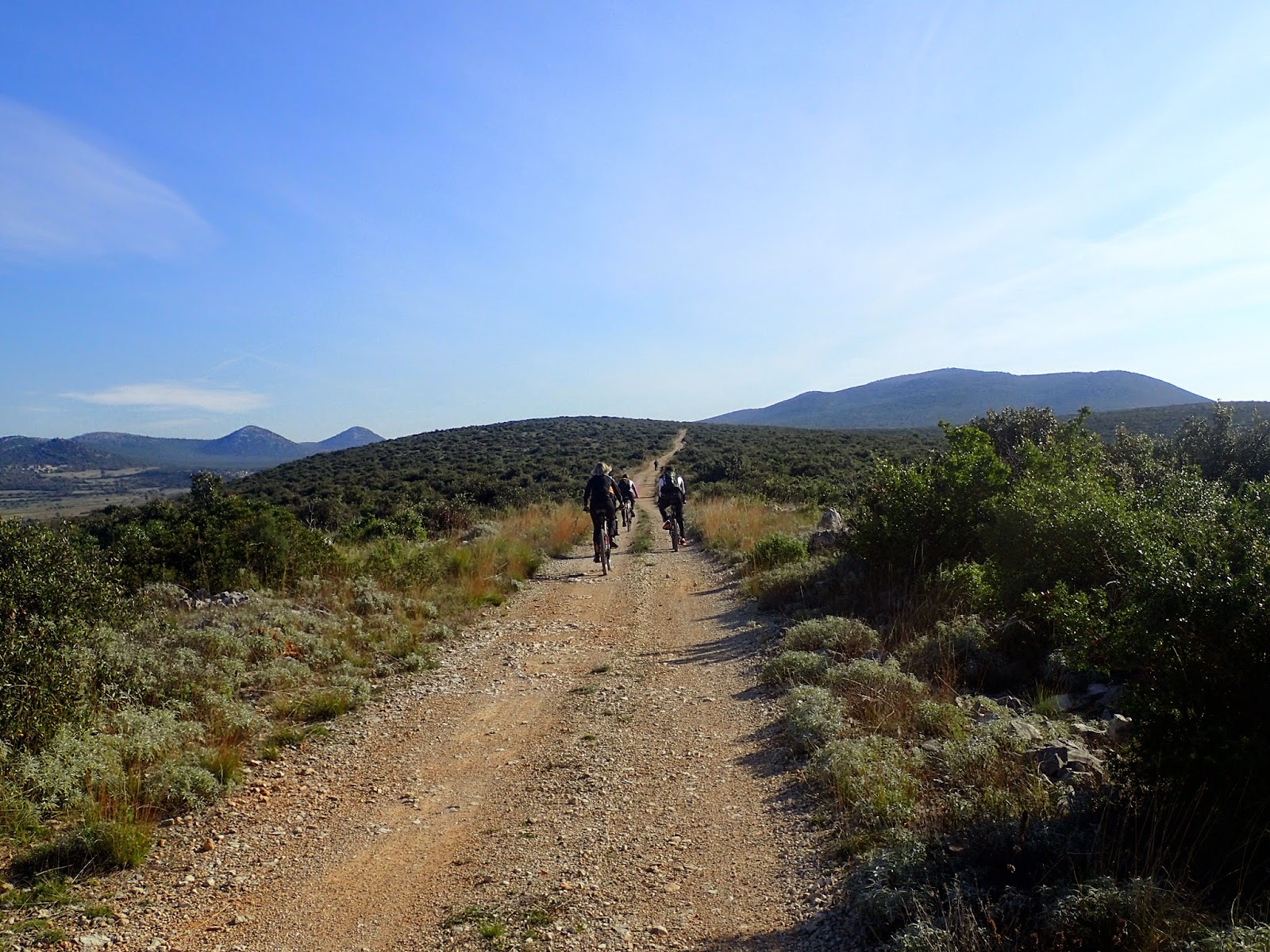
The tour around the entire lake is about 36km long, with approx. 400m of total altitude, makes it quite pleasant ride both for beginners and more advanced riders.  It is about 20% asphalted road and about 80% of the dirt road, which isn’t technical so it is manageable for most of cyclists.


And off course after amazing views and physical activity, is there a better way to finish the day than by great local meal in small locally owned agro tourism in the vicinity of the park? 


And definitely the surprise of the day was a small private concert by owners of the tavern where we had dinner. Great welcoming place with amazing hosts… Just the way it should be. :)


Saturday, November 15, 2014

IT IS NOVEMBER, so what?


Often we can hear how the tourist season ends by the end of October, and the new one starts sometime in April. But some of us keep on thinking is that really true or how this could be changed..


We have great climate, great food and wine, great places, history and architecture, beautiful scenery, but somehow this "fact" doesn't manage to exceed the popularity of the "Sun&Sea" in the summer, the peak season.

There are sooooo many different "theories" and points of view what we would need to do in order to prolong the season, but I don't feel like theorizing about it..  I know that telling people how many great things they could do in the off season and which are the benefits of visiting Croatia now, instead in August, wouldn't change this magic circle overnight, but its a start...


I could write about the climate, about facts, prices, history or just about places/destinations, but I wouldn't (at least for now). I would rather like to tell you what can you expect if you are "brave" enough to visit us NOW, in the off season, instead of peak season with the endless river of tourists just pouring into our destination.

So do you wonder what could you do if you visit Split, now, in the off season? In this and my following blogs, I would try to offer you some of the ideas and experiences.


How about a great day trip from Split to Hvar island? But not just any day trip, but a spectacular one. A day which starts with magnificent flight from Split over Brac island and Solta to Jelsa on Hvar island?


It is a fairly short flight, so much shorter than getting on a ferry. On the ferry you would travel for 2h each way and yes it is nice, but not as close to the great experience provided on ECA hydroplane flight. Yes it is only about 15 min flight, but in those 15 min you see so many amazing views that you can't believe that it all fitted in "only" 15minutes.


Starting from Split at around 8am, you are in Jelsa on Hvar island already before 8.30am. And there is a full day ahead of you to explore one of the most magnificent Adriatic islands. At this time of year the island is bit slow and sleepy, but its magic is there.  Whatever you choose to do. To get the shuttle from Jelsa to Hvar town and to explore on your own, or you could have a private island tour followed by wine tasting and lunch... All at your choice... :)

And the best about it there is plenty of time to enjoy your day and to be back in Split just on the time for dinner.